How often should you clean solar panels?
For most Melbourne homes, the honest answer is once every 12 months. That's often enough to stop the normal buildup of dust, pollen, traffic grime and bird droppings from settling into a stubborn film, without paying for cleans your panels don't really need. A yearly visit also gives you a regular, close look at the array, which matters as much as the cleaning itself.
Some homes need more. If your roof sits under trees, beside a busy road or near building work, or birds treat your panels as a perch, every six months is usually a better fit. The right schedule depends on what's around your roof, not a number picked off a calendar.
The simplest way to settle on a frequency is to start with a yearly clean, look at the before photos, and adjust from there. If the panels were heavily soiled after twelve months, book a little sooner next time. If they only carried a light layer of dust, once a year is working well for your home.
When should you clean solar panels every 6 months?
A six-monthly clean makes sense when dirt lands on your panels faster than normal weather can shift it. If any of the following describe your home, a yearly clean can leave the panels grimy for months at a time, and a shorter gap between cleans is usually worth considering:
You don't need every factor on the list for a shorter schedule to make sense. One large tree hanging over the array, or a pair of pigeons that have claimed your roof, can be enough on its own. On the other hand, once the building work next door finishes, you can usually go back to a yearly clean after the dust has been dealt with.
- Trees overhead or close by, dropping leaves, sap, seed pods and blossom onto the glass
- A busy road nearby, where traffic grime settles as a greasy film that rain tends to smear rather than remove
- Building, renovation or demolition work next door or down the street, which spreads fine dust across nearby roofs
- Regular bird activity, such as a favourite perch on the roof ridge, a TV antenna or a nearby power line
- Low-pitch or near-flat panels, where water sits along the lower edge and leaves a line of dirt behind as it dries
What are the signs your solar panels need cleaning?
Rather than relying only on the calendar, it helps to know what dirty panels look like. Most of these signs can be spotted from your backyard, an upstairs window or your solar monitoring app, with no need to go anywhere near the roof:
That last sign needs a little care. Solar output naturally rises and falls with the seasons, cloud cover and day length, so comparing a winter week with a summer week tells you very little. Compare like with like: a clear day this spring against a clear day last spring. If output looks noticeably softer and nothing else has changed, dirt is a likely cause.
Keep in mind that lower output can also point to other issues, such as new shading from a growing tree, a cracked panel or a problem with the inverter. That's another reason a clean paired with a condition inspection is a sensible first step: it rules out dirt as the cause and flags anything visible that needs your installer's attention.
- A dull, hazy or patchy film across the glass instead of a clear, even dark surface
- Bird droppings, which block light to the cells beneath them and harden the longer they sit
- Green, grey or orange lichen or moss creeping in along the lower edges of the panels
- A line of dirt or leaf litter collecting along the bottom frame where water drains off
- Output in your monitoring app looking lower than the same season last year, on similar sunny days
What is the best time of year to clean solar panels in Melbourne?
There's no wrong time to clean panels that are visibly dirty, but some timings give you more value from each visit. If you're planning a regular yearly or six-monthly clean, these are the timing windows worth aiming for here in Melbourne:
On a yearly schedule, a clean in late spring usually ticks the first two boxes at once. On a six-monthly schedule, pairing a spring clean with an autumn clean spreads the visits evenly across the year. Booking a little ahead of the busy pre-summer period also makes it easier to get the day that suits you, although Daniel generally offers same-week bookings.
- Late spring, before summer: your panels do their heaviest lifting over long summer days, so start the season with clean glass
- After spring pollen settles: pollen and blossom leave a sticky yellow film that is best cleared once the season has passed
- After nearby building work finishes: cleaning mid-project often means the dust is back within weeks, so wait until the work wraps up
- Autumn, for six-monthly schedules: a second clean after summer dust and leaf fall sets the panels up for the lower winter sun
Doesn't rain clean solar panels on its own?
Rain helps, but it isn't a cleaning schedule. A good downpour rinses loose dust off steeper panels, which is part of why many homes can go a full year between cleans. What rain doesn't do well is shift anything that's stuck on: bird droppings, sap, pollen film, traffic grime and lichen all tend to stay put.
Light rain can even make things look worse. A passing shower wets the dust without washing it away, and as the water evaporates it leaves spots and streaks behind. On low-pitch or near-flat panels, water drains slowly and deposits a band of grime along the bottom edge each time, which is exactly where lichen likes to take hold.
Melbourne weather also doesn't arrive on a neat timetable. Long dry spells over summer can leave panels dusty for weeks, right when the sun is at its strongest. Treat rain as a helpful bonus between cleans rather than a replacement for them.
What can you check on your solar panels without going on the roof?
Please don't climb onto your roof to inspect or clean your panels. Roofs are slippery, panels are fragile, and a fall from even a single-storey roof can cause serious injury. The good news is that you can learn a lot from the backyard without any risk. Here are some simple, safe checks worth doing every few months:
If you spot something, take a photo and send it through with your enquiry. It's also worth checking your panel's installation manual for any cleaning guidance. Whatever you find, avoid spraying panels with a pressure washer or reaching for household detergents, as both can damage seals and coatings or leave a residue that attracts more dirt.
- Stand back in the backyard or across the street and view the panels at an angle, where haze and droppings show up best
- Look from an upstairs window if one faces the array, using your phone camera's zoom for a closer view
- Check the lower edges for green or grey growth, and for leaves or dirt building up along the frame
- Note any new shade falling across the panels from trees that have grown or a new building next door
- Open your monitoring app and compare recent sunny days with the same time last year
- Watch for birds regularly landing on the panels or roosting on the roof nearby
What does a professional solar panel clean involve?
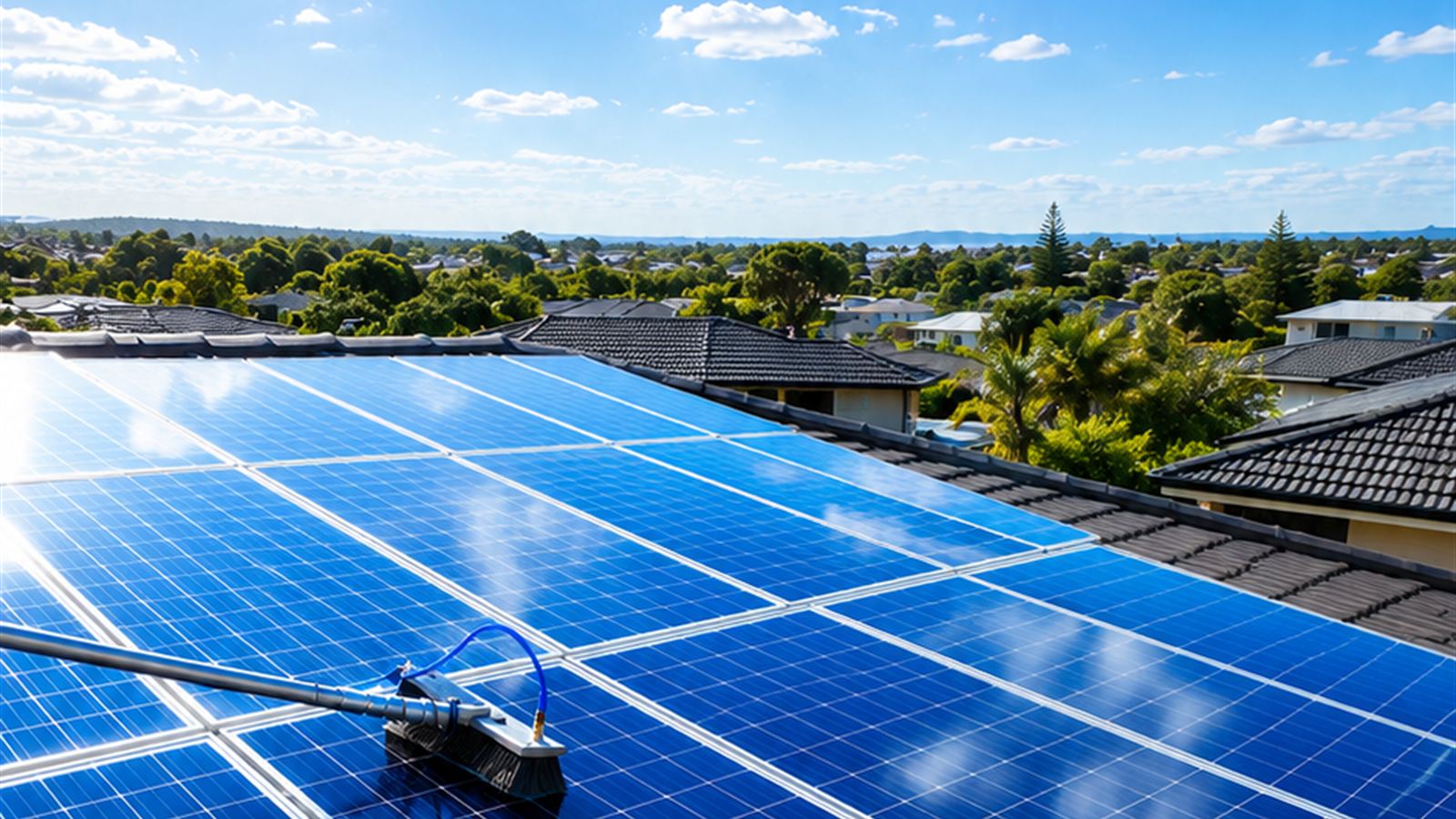
When you book with Daniels Solar Cleaning, Daniel does every job himself. He goes up on the roof using a harness and height-safety gear, then cleans the panels with deionised pure water and soft brushes. There are no detergents and no pressure washing, and the pure water dries without spotting. It's a gentle, warranty-safe method, and a typical home takes 45 to 90 minutes.
Every clean includes a free condition inspection. While he's up there, Daniel checks for cracked glass, lifted seals, loose clamps and new shading, and flags anything he finds with photos. You also get before and after photos emailed the same day, which makes it easy to see how dirty the panels were and whether your cleaning schedule needs adjusting.
Pricing is fixed and includes GST, with the same price for single or double storey homes and no call-out fee. It's $140 for up to 6 panels, $150 for 12 and $170 for 14, then $5 for each extra panel, so 22 panels is $210. If the array can't be reached safely, there's no charge.
You don't need to be home as long as there's side access. If your gutters are due as well, gutter vacuum cleaning is 10% off when booked with a solar clean, and mesh bird proofing can be quoted separately if birds are a regular problem on your roof.
Frequently asked questions
Is it worth cleaning solar panels in Melbourne?
For most homes, yes. Dust, pollen, traffic grime and bird droppings build up over time and block sunlight from reaching the cells. A yearly clean keeps the glass clear, and the free condition inspection that comes with it can pick up cracked glass, lifted seals or loose clamps early, before a small issue turns into a bigger one.
Can I clean my solar panels myself?
It's not recommended if it means getting on the roof. Roofs and panels are slippery, and falls cause serious injuries. Pressure washers, stiff brushes and detergents can also damage panels or leave residue behind. Check your panel's installation manual for guidance, keep your own checks to the backyard, and leave roof work to someone with proper height-safety gear.
Does cleaning solar panels void the warranty?
Gentle cleaning shouldn't cause problems, but harsh methods can. Daniel uses deionised pure water and soft brushes, with no detergents and no pressure washing, which is a warranty-safe approach. Warranty terms vary between products, so it's worth reading your panel's installation manual or warranty documents for any specific cleaning guidance.
How long does a solar panel clean take?
A typical home takes between 45 and 90 minutes, depending on the number of panels, how dirty they are and how the roof is accessed. You don't need to be home if there's side access, and before and after photos, along with any issues found during the free condition inspection, are emailed to you the same day.
How much does it cost to clean solar panels in Melbourne?
Daniels Solar Cleaning uses fixed prices that include GST, the same for single or double storey homes, with no call-out fee. It's $140 for up to 6 panels, $150 for 12 and $170 for 14, then $5 per extra panel, so 18 panels is $190 and 28 panels is $240.